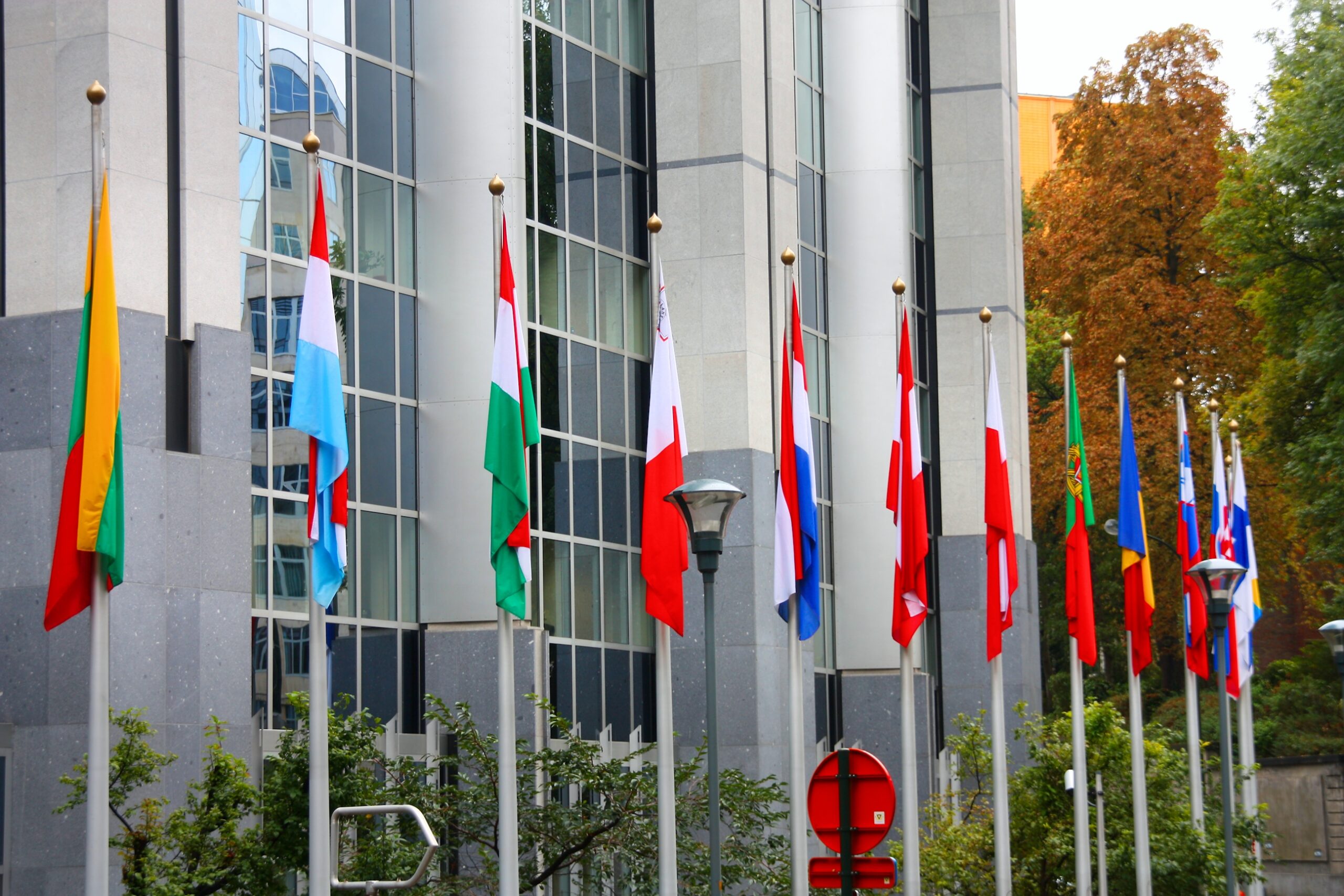
Walk past a public building in Rome on a working Tuesday and the Italian Tricolour will be hanging beside the EU flag, both raised at the same height, both lowered before sunset, both subject to a dense body of rules whose breach can be prosecuted. Do the same in Berlin and you’ll find the Bundesflagge flown only on a list of statutorily prescribed days, while the version bearing the federal eagle is reserved for ministries and forbidden on a private balcony. Cross into Paris and the Tricolore is everywhere on official buildings, yet no consolidated statute governs how it must look — the rules live in scattered decrees, ministerial circulars and a 2010 amendment to the Criminal Code. Three neighbouring republics, three almost incompatible legal philosophies for the same simple object: a coloured rectangle hoisted on a pole.
Why this matters
If you live in the European Union, you encounter national flags constantly: on town halls, schools, embassies, balconies during football tournaments. If you fly one yourself, sell them, or organise events at which one will be raised, the rules around how it must be done are far from intuitive — and they change at every border. A flag hung upside down can be a fineable offence in one country and pure folklore in the next. A national flag displayed without the EU flag beside it can violate a regulation in Vilnius and be irrelevant in Stockholm. Sanctions range from a €12 administrative warning in Lithuania to up to three years’ imprisonment in Germany. For flag professionals, event managers, diplomats and the merely curious, this article is a working reference: what the 27 EU member states actually require, where the regimes converge, and where they diverge sharply enough to matter.
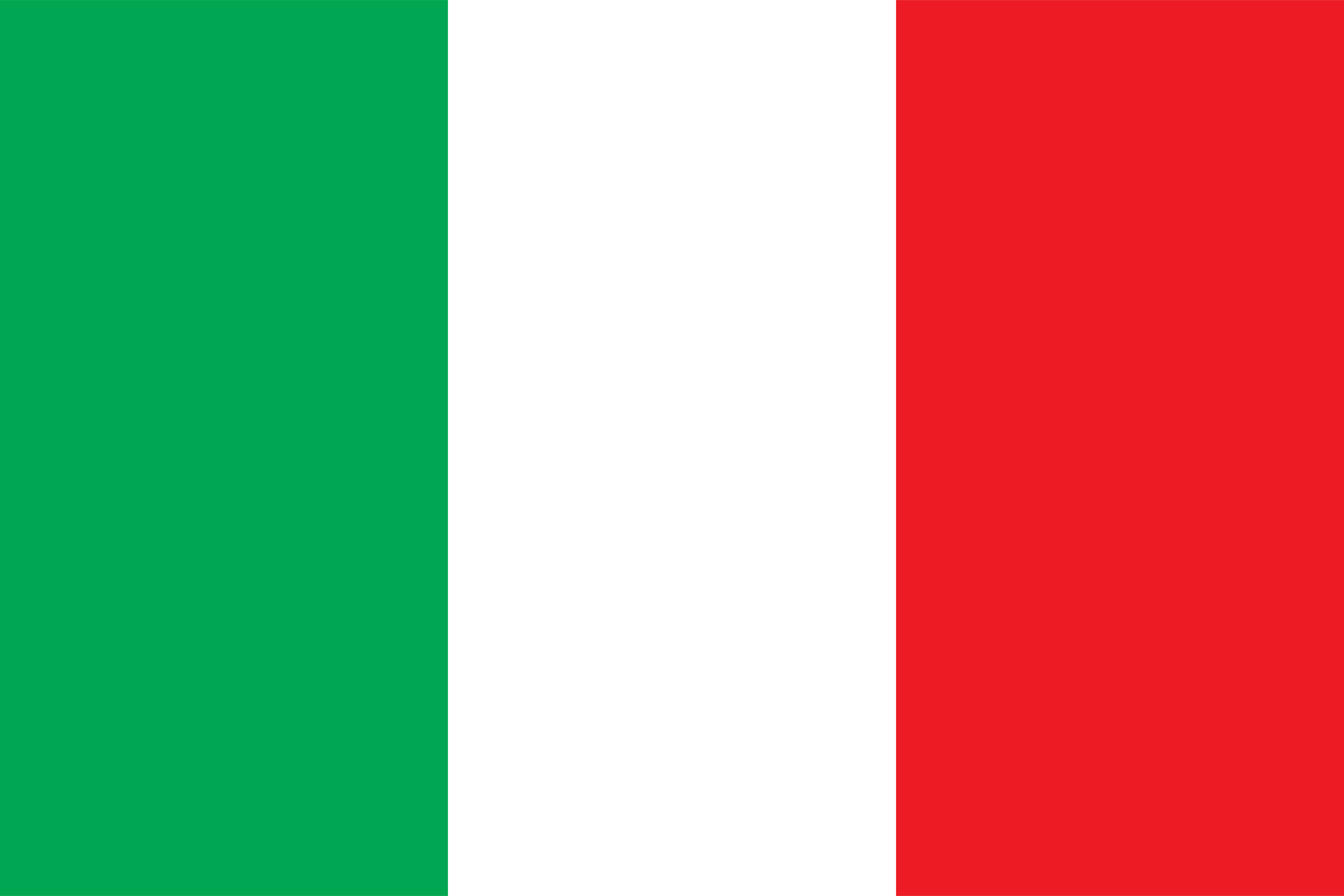
Italy Flag
- Adopted
- 1 January 1948
- Proportions
- 2:3
- FIAV usage
- Used as civil, state and military flag, on land and at sea.
- Official status
- ⊕Officially adopted by national law
- Colors
- Designer
- —
- Predecessor
- Cispadane Republic flag (1797)
- Regulatory document
- DPR 121/2000
- Design family
- Horizontal tricolour
Four families of European flag law
Despite 27 separate legal traditions, the regimes cluster into four recognisable families.
The first is the strict statutory family — countries that codify the flag in detailed legislation, attach criminal sanctions to its misuse and prescribe protocols down to the proportions and Pantone codes. Italy (DPR 121/2000 and Law 22/1998), Germany (Anordnung des Bundespräsidenten 1996; § 90a StGB), Spain (Ley 39/1981), Portugal (Decreto-Lei 150/87) and Bulgaria (Закон за държавния печат и националното знаме, 1998) all sit here. The state owns the symbol, and citizens use it under conditions.
The second is the post-1989 Central European family — a cluster of nations that rewrote their flag laws shortly after the fall of communism or after independence, often in the early- to mid-1990s. Poland (1980, heavily amended 2004), Czechia (Act 352/2001), Slovakia (Act 63/1993), Hungary (Act CCII of 2011, replacing 1995’s Act LXXXIII), Slovenia (1994), Croatia (1990–1994), Romania (Law 75/1994), Estonia (Eesti lipu seadus 2005), Latvia (2009) and Lithuania (1991, revised 2004) share a recognisable signature: long statutory texts; detailed lists of buildings on which display is mandatory; designated Flag Days; administrative fines for non-compliance; and frequently a second, “historical” variant of the flag (Vytis in Lithuania, the arms-bearing state flag in Slovakia, Slovenia, Hungary).
The third is the constitutional minimalism family — states where the flag is defined at constitutional level but the protocol of display lives almost entirely in advisory documents. Ireland (no statutory code; only the Department of the Taoiseach’s National Flag protocol), Cyprus (1960 Constitution Art. 4), Malta (1964 Constitution Art. 3 plus the Public Holidays Act) and France (Constitution Art. 2 plus scattered decrees) all rely on guidance more than statute, even though France attaches a criminal sanction to public outrage of the flag.
The fourth is the Nordic-liberal family — countries where the flag is everyday, household property and the state legislates only the bare technicalities. Sweden (Lag 1982:269), Denmark (Lov om flagning 2024 and the 1854/1939 royal resolutions), Finland (Laki Suomen lipusta 380/1978) and the Netherlands (Vlaginstructie 2013, a non-statutory instruction) form this group. Private use is encouraged, often domestic and ritualised; statutory regulation is light; flag-desecration as a crime is largely absent.
Country-by-country spotlights
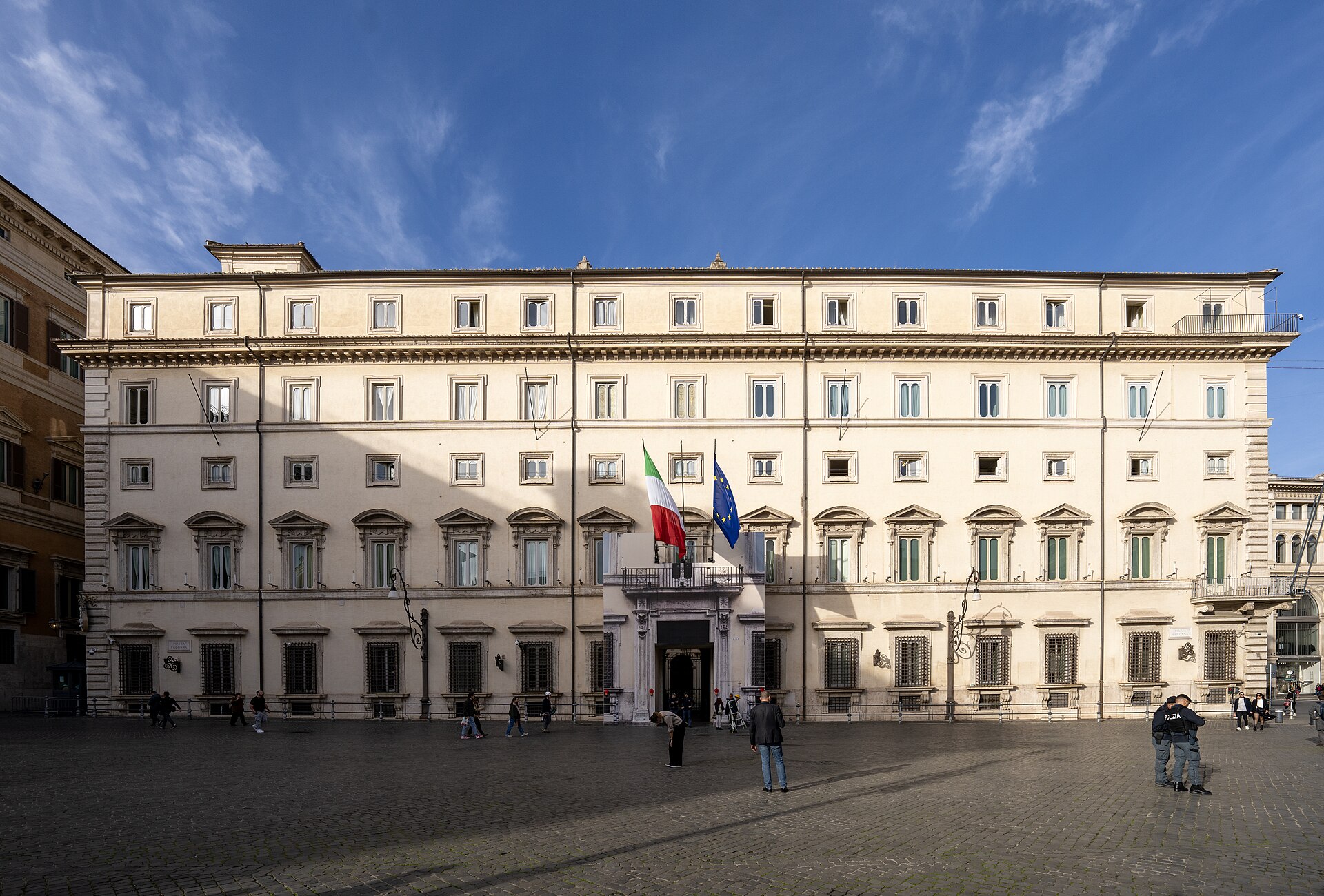
Italy has the most disciplined dual-flag protocol in Europe. DPR 121/2000 implements Law 22/1998 and prescribes that the Italian flag and the EU flag be flown on every state administration building, every public school on lesson and exam days, and every prefecture. The two flags must be of equal size, on poles of the same height; the Tricolour takes the heraldic right (the viewer’s left); odd-numbered arrangements place the national flag in the centre. Vilipendio della bandiera — defamation — is criminalised under Article 292-bis of the Criminal Code, punishable with fines from €1,000 to €5,000. If you sell or display the Italian flag for official use, the proportions are 2:3 and the green band must be on the hoist side.
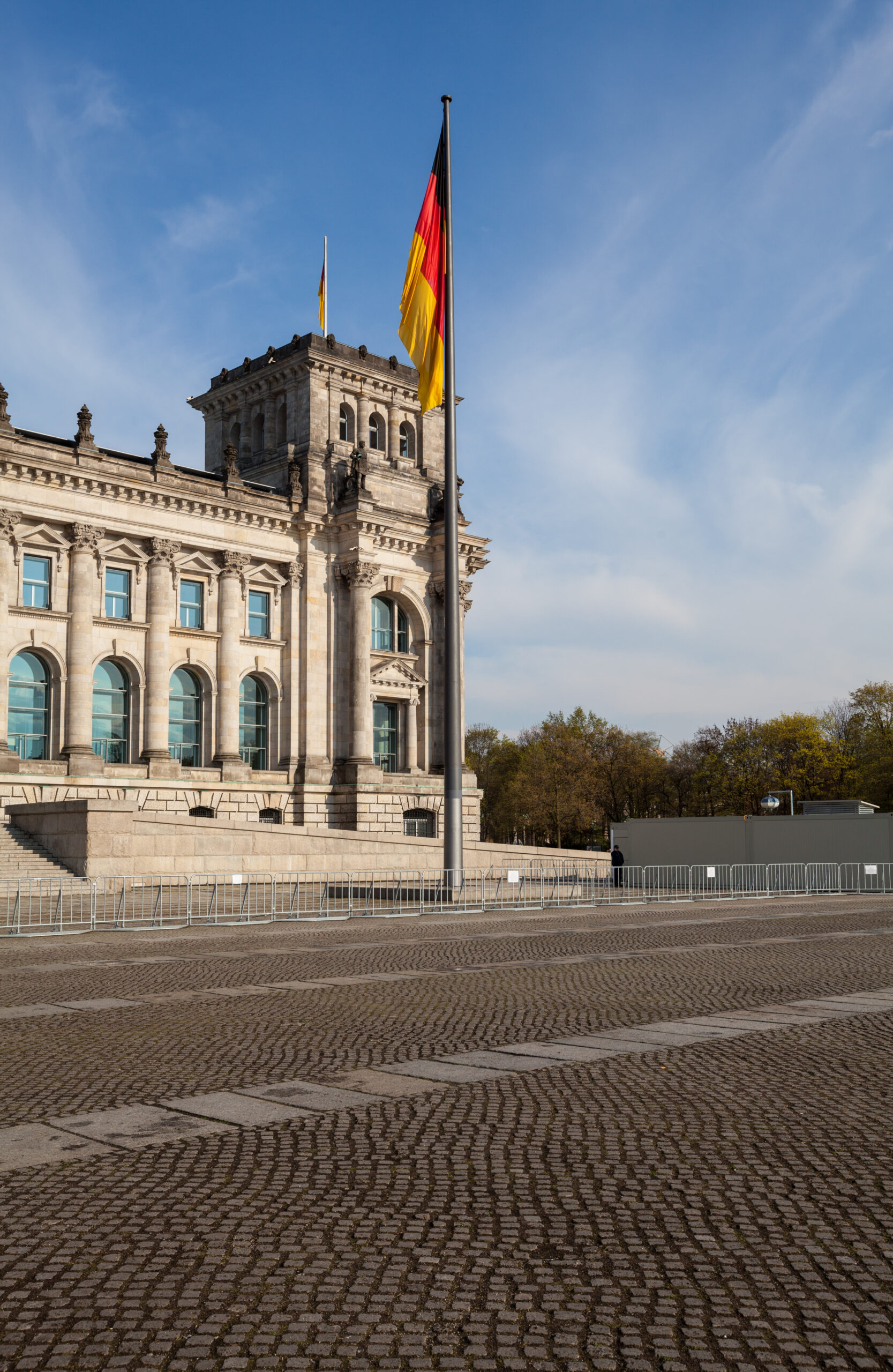
Germany is the only EU state with two distinct official flags: the civil Bundesflagge (black-red-gold horizontal stripes, 3:5) that anyone may fly, and the Bundesdienstflagge bearing the federal eagle, reserved exclusively for federal authorities. Misuse of the latter is sanctionable. The 1996 Anordnung des Bundespräsidenten and the 2005 Erlass über die Beflaggung der Dienstgebäude des Bundes specify which dates federal buildings must hoist the flag; the Länder regulate their own. Section 90a of the Criminal Code (Strafgesetzbuch) makes flag desecration a serious offence — up to three years’ imprisonment, or five years if connected to anti-constitutional activity. The post-1949 legal scaffolding remains visibly shaped by the determination to prevent the resurgence of unauthorised national symbolism.
France has the most counter-intuitive regime among Europe’s large states: there is no comprehensive statute on the display of the drapeau tricolore. The Constitution defines it; ministerial circulars and prefectural instructions tell town halls when to hoist it; and Décret 2010-835 inserted Article R645-15 into the Criminal Code, making public outrage to the flag a fifth-class contravention with a fine up to €1,500. A 2019 law (loi pour une école de la confiance) requires every classroom to display the French and EU flags. France also institutionalised the EU flag’s place on official buildings after 2008.
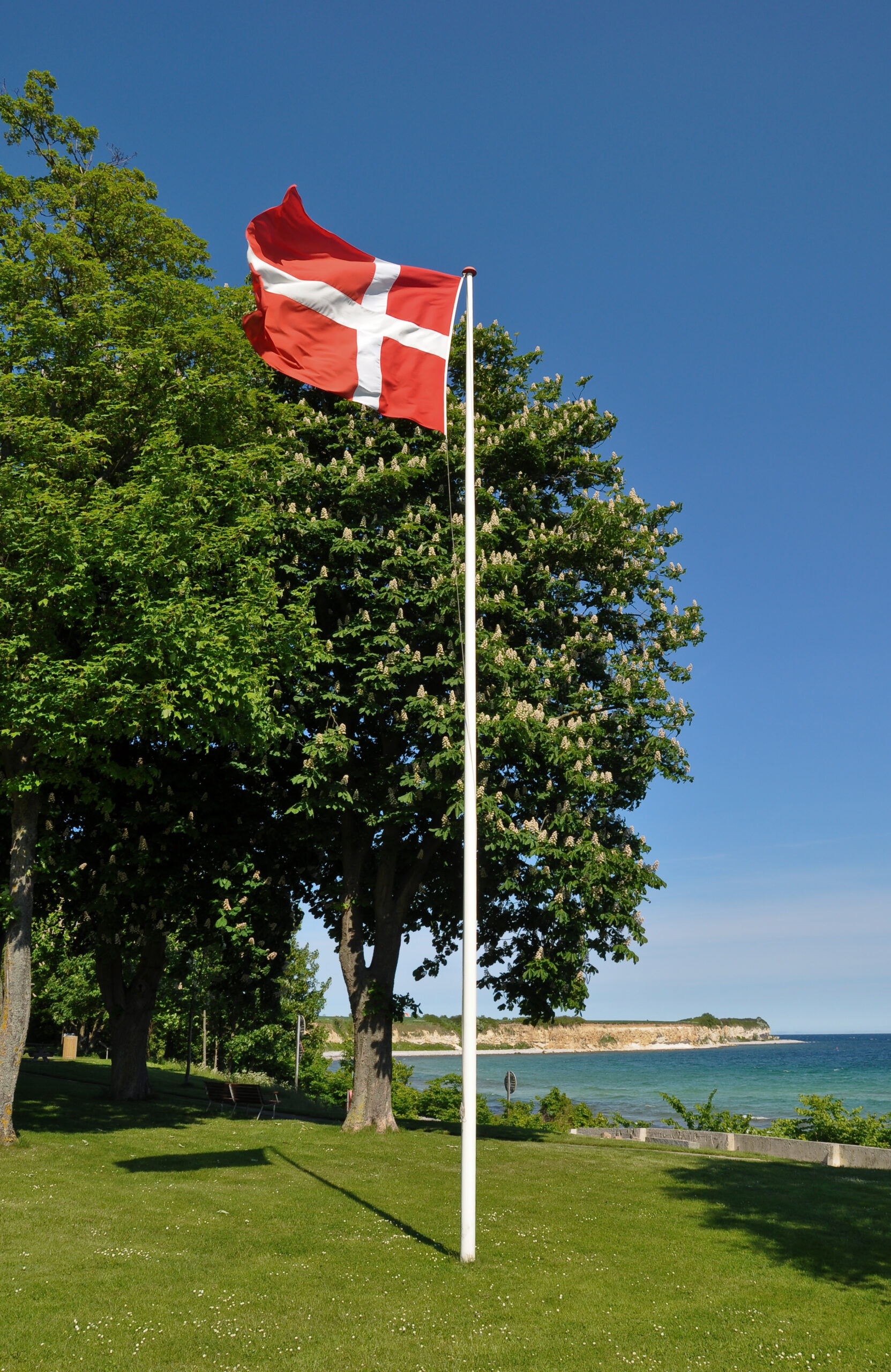
Denmark is the European outlier — the only country where private daily flag use is genuinely vernacular. The Dannebrog is hoisted by ordinary households on personal birthdays, weddings and national days; thirteen official flag days punctuate the calendar. The 1854 royal resolution legalised private rectangular use; the 1939 resolution fixed the geometry of the swallow-tailed Splitflag, which remains a state monopoly. In December 2024 a new flag act re-tightened the rules on foreign flag display after a 2023 Supreme Court ruling had briefly liberalised them — a reminder that Nordic permissiveness has limits.
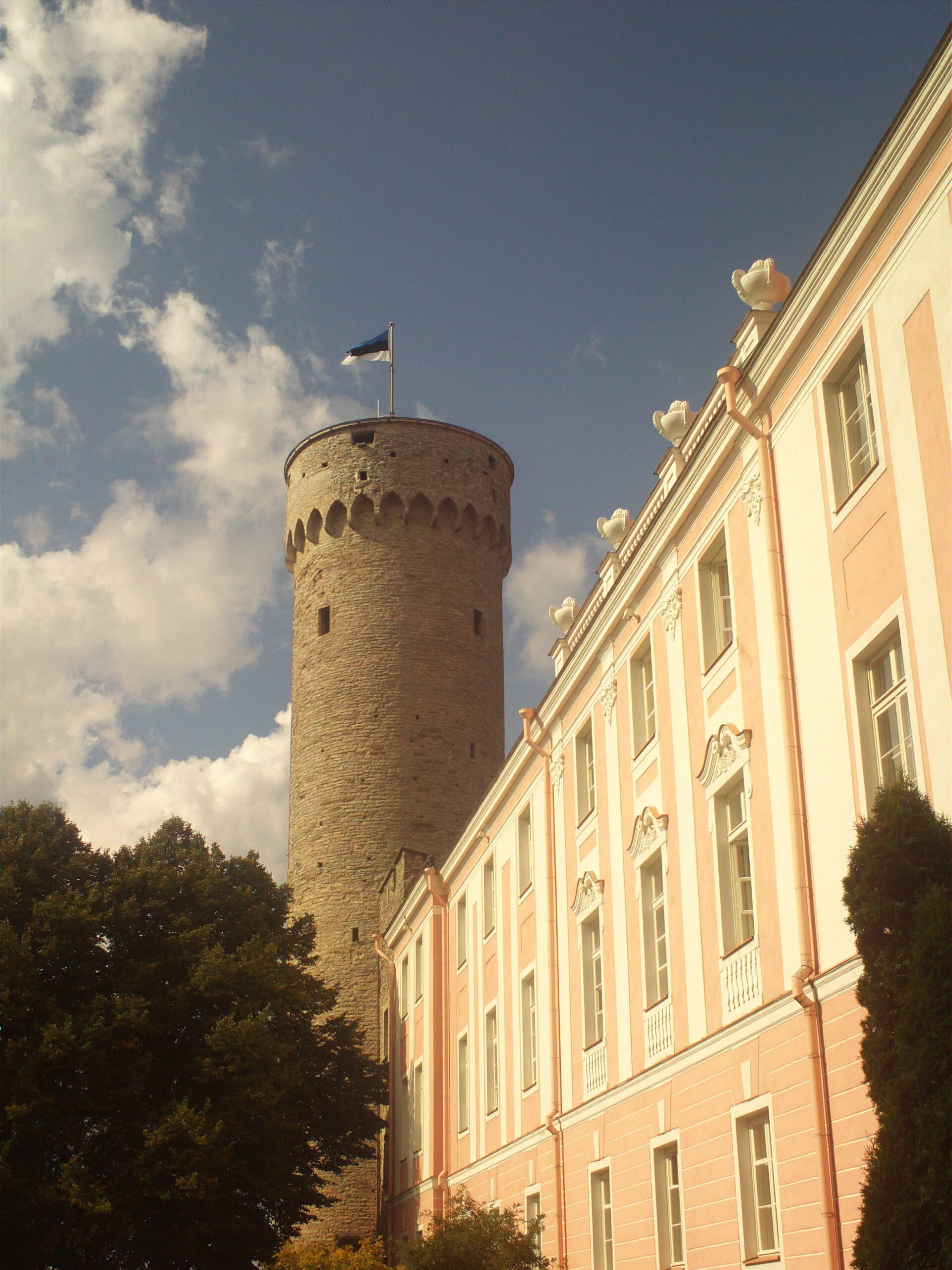
Estonia has the strictest school-flag regime in the EU. The Eesti lipu seadus (2005) mandates that every school hoist the blue-black-white tricolour every single school day. The flag is also required on more than sixteen statutory flag days, on Pikk Hermann tower in Tallinn permanently, and on courts, ministries and local-government buildings on prescribed dates. Failure by responsible officials is sanctioned as a misdemeanour under § 14 of the Act. The flag’s 7:11 proportions are unusually elongated; raising occurs no earlier than 07:00 and lowering at sunset.
Ireland is the most legally hands-off member state. There is no statute, no penal sanction, no enforcement apparatus — only the Department of the Taoiseach’s protocol document, most recently updated in 2016. The tricolour must be flown with green at the hoist, must never be flown below another flag, and must never be dipped except in honour of the dead. Beyond that, display is encouraged by educational charities but never imposed by law. It is the cleanest example of the constitutional-minimalist family.
Spain built one of the most precedence-heavy regimes in Europe. Ley 39/1981 requires the Spanish flag to be permanently flown on every public administration building — state, autonomous community and municipal — and prescribes that when displayed beside a regional flag the national flag must be larger or at least equal in size, and in the most honourable position. The Supreme Court has repeatedly intervened where municipalities have failed to comply. Article 543 of the Criminal Code penalises public outrages against Spain and its symbols with fines of seven to twelve months’ worth of daily income.
Poland rewrote its 1980 statute in 2004 to legalise free private use of the flag — explicitly enabling the wave of patriotic display now visible on Dzień Flagi (2 May), a date Parliament wedged between Labour Day and Constitution Day to encourage mass civic flag-flying. The state flag bearing the eagle remains restricted to diplomatic missions, ports, airports and ships. Article 137 §1 of the Penal Code criminalises public insult of the flag with a fine, restriction of liberty or up to one year’s imprisonment. The 2024 consolidated text reflects more than a decade of incremental amendment.
Common ground and sharp divergences
Across all 27 member states three rules are universal. First, the flag must be treated with dignity — even Sweden, which has no desecration offence, expects the state flag not to be soiled or displayed in ways calculated to insult. Second, the flag is never flown below another flag on the same pole. Third, in joint display with the EU flag, the national flag retains the place of honour in its own territory.
Beyond that consensus the regimes diverge sharply. Criminal sanctions exist in Italy, Germany, France, Spain, Portugal, Poland, Hungary, Greece, Bulgaria, Croatia and Luxembourg; administrative-only sanctions in Czechia, Slovakia, Slovenia, Estonia, Latvia, Lithuania, Romania, Austria and (now) Denmark; no sanctions at all in Ireland, the Netherlands and Sweden. Mandatory school display is the norm in Estonia, Slovakia, France and Italy and absent in the Nordic states. Permanent illumination after sunset is required by statute in Italy and Portugal but only customary in the Netherlands. Lithuania mandates display on private residential buildings on the three statehood holidays — an obligation no Western European state imposes.
The EU flag dimension
Twenty-six of the twenty-seven member states have explicitly integrated the European flag into their national protocol. The dominant pattern is symmetric pairing: equal size, equal pole height, the national flag in the place of honour with the EU flag immediately beside it. Italy codified this symmetric pairing in DPR 121/2000 in unusual detail — the EU flag is treated almost as a peer rather than a guest. France did the same through ministerial practice after 2008, when President Sarkozy formalised the EU flag’s presence on official buildings, and the 2019 schools law made the pairing mandatory in classrooms. Romania, Lithuania and Estonia all list the EU flag explicitly in their statutes.
The only member state without statutory accommodation of the EU flag is, in practice, Sweden — whose 1982 Act simply does not contemplate it, leaving the matter to convention. The Netherlands sits in a similar position by virtue of having no statute to amend. Denmark’s 2024 act listed the EU flag among the foreign emblems whose display is by default permitted alongside the Dannebrog, which is itself a legislative innovation worth noting.
Practical takeaways for flag professionals and enthusiasts
A working checklist for anyone handling national flags across multiple EU jurisdictions: the proportions are 2:3 in most of the Union, with significant exceptions including Ireland (1:2), Hungary (1:2), Lithuania (3:5), Sweden (10:16), Denmark (28:37) and Estonia (7:11). Criminal liability for desecration applies in roughly two-thirds of the member states; assume risk unless you have confirmed otherwise. The EU flag should be treated as paired with the national flag on every official building in Italy, France, Romania, Lithuania, Estonia, Slovenia and most others. Sunrise-to-sunset display is the default rule everywhere; statutory illumination requirements apply in Italy and Portugal. Mandatory mourning configurations (half-mast and, in Latvia, the black ribbon) are codified in detail in Latvia, Italy, Slovenia and Hungary. When in doubt, default to the strictest reasonable interpretation: equal pole heights, place of honour to the national flag, sunrise-to-sunset, clean cloth, correct hoist side.
Country-by-country quick reference
| Country | Primary law / regulation | Sanctions | Notable peculiarity (one line) |
|---|---|---|---|
| Austria | Wappengesetz, BGBl. 159/1984 | Yes — administrative, up to €3,600 | Liberal “private use” clause expressly allows everyday depictions of arms and flag. |
| Belgium | Arrêté royal du 5 juillet 1974 (amended 2013, 2015) | No specific desecration penalty; only administrative non-compliance | No criminal offence for flag desecration; official “Meldpunt Bevlagging” reporting line exists. |
| Bulgaria | Закон за държавния печат и националното знаме | Yes — administrative fines + Criminal Code Art. 108 (up to 2 yrs) | Statute specifies Pantone textile codes and exact whiteness percentage. |
| Croatia | Zakon o grbu, zastavi i himni RH | Yes — administrative + Criminal Code Art. 349 (up to 1 yr) | Coat of arms includes five regional sub-shields representing historical Croatian regions. |
| Cyprus | Constitution Art. 4 + Council of Ministers decision 24 April 2006 | Limited — general criminal-code provisions only | Only sovereign flag depicting its own geographical map; constitution bans Greek/Turkish colours. |
| Czechia | Zákon č. 352/2001 Sb. | Yes — administrative, up to CZK 30,000 | Statute expressly allows anyone to fly the state flag “at any time” if done with dignity. |
| Denmark | Lov om flagning 2024; royal resolutions 1854, 1939 | Yes — administrative (foreign-flag rules); Straffeloven §110e for foreign-state insults | Daily private use is vernacular; swallow-tailed Splitflag is a state monopoly. |
| Estonia | Eesti lipu seadus | Yes — misdemeanour sanctions under § 14 | Mandatory display on every school every school day; 7:11 elongated proportions. |
| Finland | Laki Suomen lipusta 380/1978 | Yes — fines under §8 for unlawful state/presidential flag use | Midsummer’s Day flag remains hoisted overnight — a national exception to the sunrise-sunset rule. |
| France | Constitution Art. 2 + Décret 2010-835 (Code pénal R645-15) | Yes — fifth-class contravention, up to €1,500 (€3,000 recidivist) | No comprehensive flag-display statute; rules dispersed in decrees and circulars. |
| Germany | Anordnung des Bundespräsidenten 1996 + Erlass 2005 | Yes — § 90a StGB, up to 3 yrs (5 yrs if anti-constitutional) | Two distinct official flags: civil Bundesflagge free, Bundesdienstflagge state-only. |
| Greece | Νόμος 851/1978 (Government Gazette FEK A’ 233/1978) | Yes — Penal Code Art. 181, up to 2 yrs | 1978 law abolished the older land flag and made the striped maritime flag the sole national flag. |
| Hungary | 2011. évi CCII. törvény (replaced 1995 Act LXXXIII) | Yes — Criminal Code §334 (up to 1 yr) + administrative fines | Use of the coat of arms requires explicit authorisation from the Prime Minister’s Office. |
| Ireland | The National Flag (Department of the Taoiseach protocol) | None — protocol is advisory | No statutory code, no penalty; the most legally hands-off regime in the EU. |
| Italy | Legge 22/1998 + DPR 121/2000 + Codice penale art. 292-bis | Yes — criminal fine €1,000–€5,000 | Mandates symmetric pairing of Italian flag and EU flag at equal height on all state buildings. |
| Latvia | Latvijas valsts karoga likums | Yes — administrative under the Administrative Violations framework | Codifies mandatory black mourning ribbon of precise width (1/20 of flag width) on 5 designated days. |
| Lithuania | Valstybės vėliavos ir kitų vėliavų įstatymas (1991, revised 2004) | Yes — administrative, €10–€12 (Code of Administrative Offences Art. 519) | Mandatory private-building display on three statehood holidays; legalised second “historical” Vytis flag. |
| Luxembourg | Loi du 23 juin 1972 sur les emblèmes nationaux | Yes — criminal penalties for unauthorised state-emblem use | Legally recognises two parallel flags: red-white-blue tricolour and the “Roude Léiw” lion banner. |
| Malta | Constitution of Malta Art. 3 + National Holidays Act (Chapter 252) | Yes — Criminal Code Art. 73 (dignity of state) | Only national flag in the world incorporating a foreign military decoration (the George Cross). |
| Netherlands | Vlaginstructie Rijksoverheid | None — guideline only, no statute | No statutory flag law; orange royal pennant (oranje wimpel) is a unique national feature. |
| Poland | Ustawa o godle, barwach i hymnie RP | Yes — Penal Code Art. 137 §1 (up to 1 yr) | National Flag Day on 2 May, established 2004 between Labour Day and Constitution Day. |
| Portugal | Decreto-Lei n.º 150/87 | Yes — Criminal Code Art. 332, up to 2 yrs | Prescribes exact 09:00 hoisting time and ritual incineration of unusable flags. |
| Romania | Legea nr. 75/1994 | Yes — administrative, 10,000–20,000 lei (~€2,000–4,000) | Exhaustive statutory list of institutions required to fly the flag; bans superimposed inscriptions. |
| Slovakia | Zákon č. 63/1993 Z. z. | Yes — administrative, up to ~€6,638 | Statutory requirement that the flag and emblem be displayed inside every school classroom. |
| Slovenia | ZGZH (Uradni list 67/1994) | Yes — administrative under Chapter V (some fine amounts unresolved tolar/euro) | Distinguishes a state flag (with arms) from a plain “Slovenian national flag” — dual-flag concept rare in the EU. |
| Spain | Ley 39/1981 + Código Penal art. 543 | Yes — criminal fine of 7–12 months’ daily income | Heaviest precedence regime: national flag must always be larger or equal to regional/municipal flags. |
| Sweden | Lag (1982:269) om Sveriges flagga + Förordning 1983:826 | None — Sweden has no flag-desecration offence | Burning the flag in protest is legally permitted; rectangular flag free for private use, swallow-tailed reserved. |
Sources and further reading
A full machine-readable comparison of the 27 statutes, with sanctions and peculiarities, is available in the quick-reference table above.
- Italy — DPR n. 121/2000 (2000) · Legge 22/1998 (1998) — presidenza.governo.it
- Germany — Anordnung des Bundespräsidenten (1996) · Erlass (2005) · § 90a StGB — protokoll-inland.de
- France — Décret 2010-835 (2010) · Constitution Art. 2 — legifrance.gouv.fr
- Spain — Ley 39/1981 (1981) · Código Penal art. 543 — boe.es
- Portugal — Decreto-Lei n.º 150/87 (1987) — diariodarepublica.pt
- Belgium — Arrêté royal du 5 juillet 1974 (1974), amended (2013) and (2015) — etaamb.openjustice.be
- Netherlands — Vlaginstructie Rijksoverheid (2013) — rijksoverheid.nl
- Luxembourg — Loi du 23 juin 1972 (1972), amended (1993) and (2007) — legilux.public.lu
- Ireland — The National Flag, Department of the Taoiseach protocol (2016, latest revision) — gov.ie
- Sweden — Lag (1982:269) om Sveriges flagga (1982) — riksdagen.se
- Denmark — Lov om flagning (2024) · royal resolutions (1854) and (1939) — retsinformation.dk
- Finland — Laki Suomen lipusta 380/1978 (1978) — finlex.fi
- Austria — Wappengesetz BGBl. 159/1984 (1984) — ris.bka.gv.at
- Czechia — Zákon č. 352/2001 Sb. (2001) — zakonyprolidi.cz
- Poland — Ustawa o godle, barwach i hymnie RP (1980), amended (2004), consolidated (2024) — isap.sejm.gov.pl
- Slovakia — Zákon č. 63/1993 Z. z. (1993), amended (post-2018) — slov-lex.sk
- Hungary — 2011. évi CCII. törvény (2011) — net.jogtar.hu
- Slovenia — ZGZH, Uradni list 67/1994 (1994) — pisrs.si
- Croatia — Zakon o grbu, zastavi i himni RH (1990), amended (1993) and (1994) — narodne-novine.nn.hr
- Romania — Legea nr. 75/1994 (1994) — legislatie.just.ro
- Bulgaria — Закон за държавния печат и националното знаме (1998) — lex.bg
- Estonia — Eesti lipu seadus (2005) — riigiteataja.ee
- Latvia — Latvijas valsts karoga likums (2009) — likumi.lv
- Lithuania — Lietuvos Respublikos valstybės vėliavos įstatymas (1991), revised (2004) — e-seimas.lrs.lt
- Greece — Νόμος 851/1978 (1978) — crwflags.com — FOTW translation
- Cyprus — Constitution of the Republic of Cyprus, Art. 4 (1960, revised 2006) — constituteproject.org
- Malta — Constitution of Malta, Art. 3 (1964) — legislation.mt
Note on sources: this comparative draws on primary legal texts and official government materials for 24 of the 27 member states. For Greece, Cyprus and Malta, where the original statutory text was not accessible during research, the analysis relies on secondary references (Flags of the World, academic vexillology sources). Readers with access to primary sources for these three jurisdictions are warmly invited to write in with corrections.