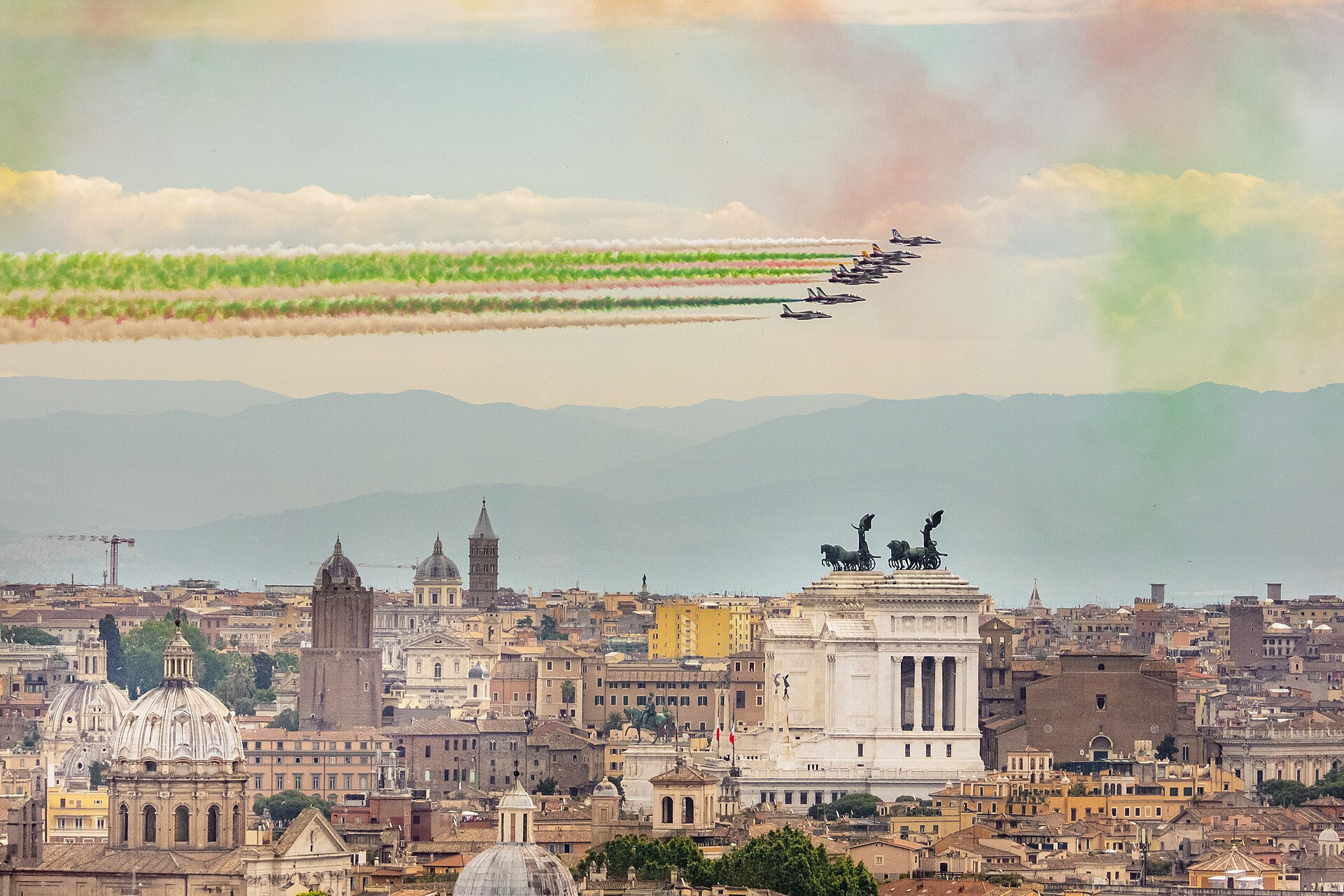
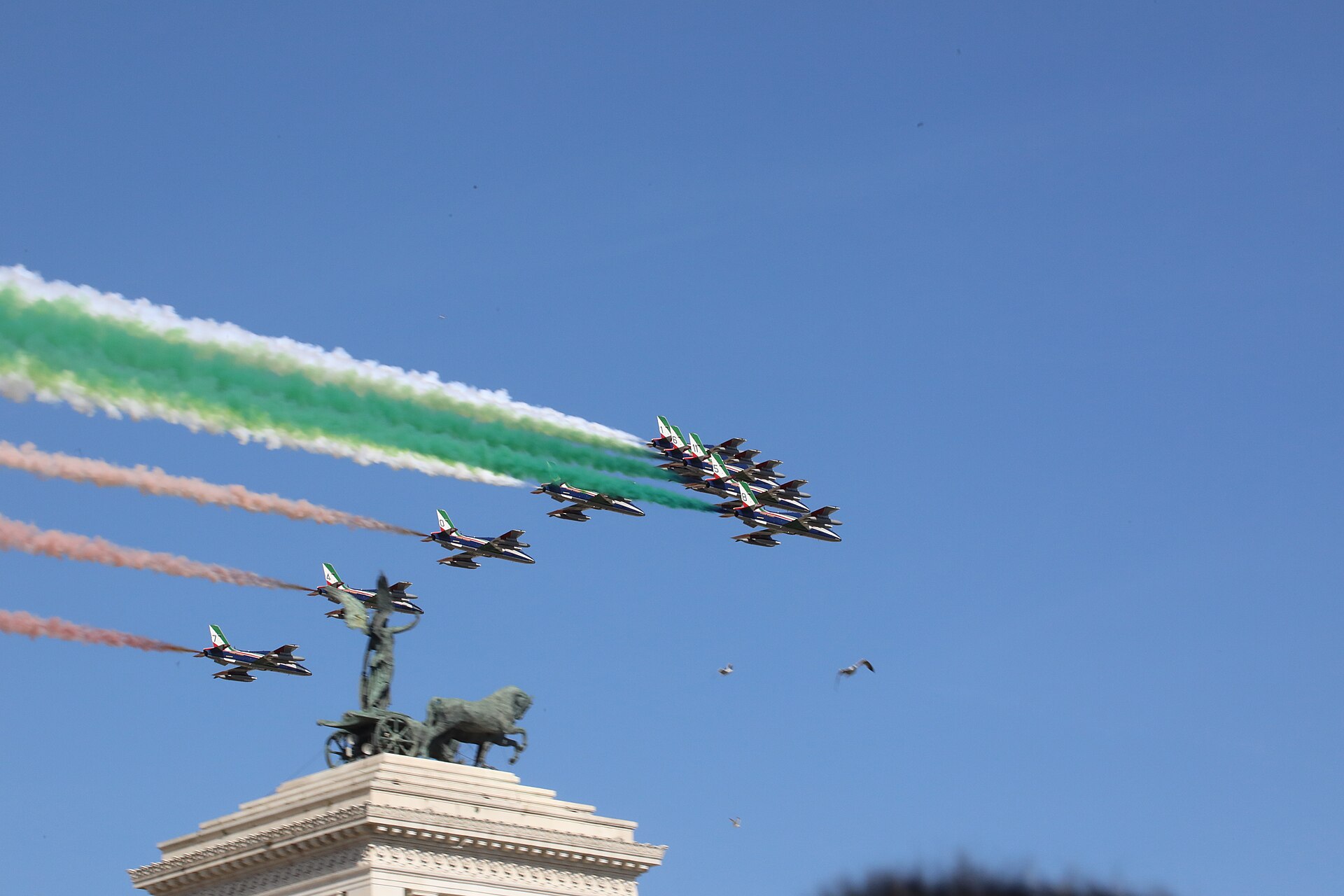
On 2 June 2026, Italy turns the page on the eightieth year since the institutional referendum that abolished the monarchy and inaugurated the Republic. The Frecce Tricolori — the Italian Air Force’s aerobatic team — will trail green, white and red smoke over the Altare della Patria, the white-marble monument to Italy’s unification that anchors the centre of Rome. The President will review the parade along Via dei Fori Imperiali; prefectures from Aosta to Lampedusa will host receptions where tricolour cockades are pinned to lapels with the reverence usually reserved for a personal vow. Behind the choreography is a flag older than the Republic that flies it. The tricolore was drafted in 1797 in Reggio Emilia — a year before France formalised its own vertical version, fifty-one years before the Albertine Statute (the 1848 royal charter that served as Italy’s constitution until 1948), one hundred and forty-nine years before the ballot that made it republican by law. The eightieth anniversary of Festa della Repubblica is therefore less a birthday than a stress test: a moment to examine how a piece of cloth, once revolutionary, has been reabsorbed into the most ordinary fabric of Italian civic life.
Why this matters
For European readers, Italy’s tricolore is the paradigmatic case study in how a national flag survives regime change. Few national symbols have been quite so reused: it has flown over a Napoleonic client republic, the Risorgimento (Italy’s 19th-century unification movement), a constitutional monarchy with a Savoy coat of arms in the centre, a Fascist appropriation alongside the lictor’s fasces (the bundled-rods symbol of Roman authority that Mussolini’s regime made its emblem), the partisan resistance of 1943-45, and the modern parliamentary republic. The same three bands tracked all of it. That continuity makes the Italian flag a useful lens on how vexillological tradition can mask, paper over, or genuinely transcend political rupture — a question that recurs from Romanian 1989 to Hungarian 1956 to Greek 1974. The eightieth anniversary year, with the comprehensive 2000 codification under DPR 121 now itself a quarter-century old, is a natural moment to take stock.
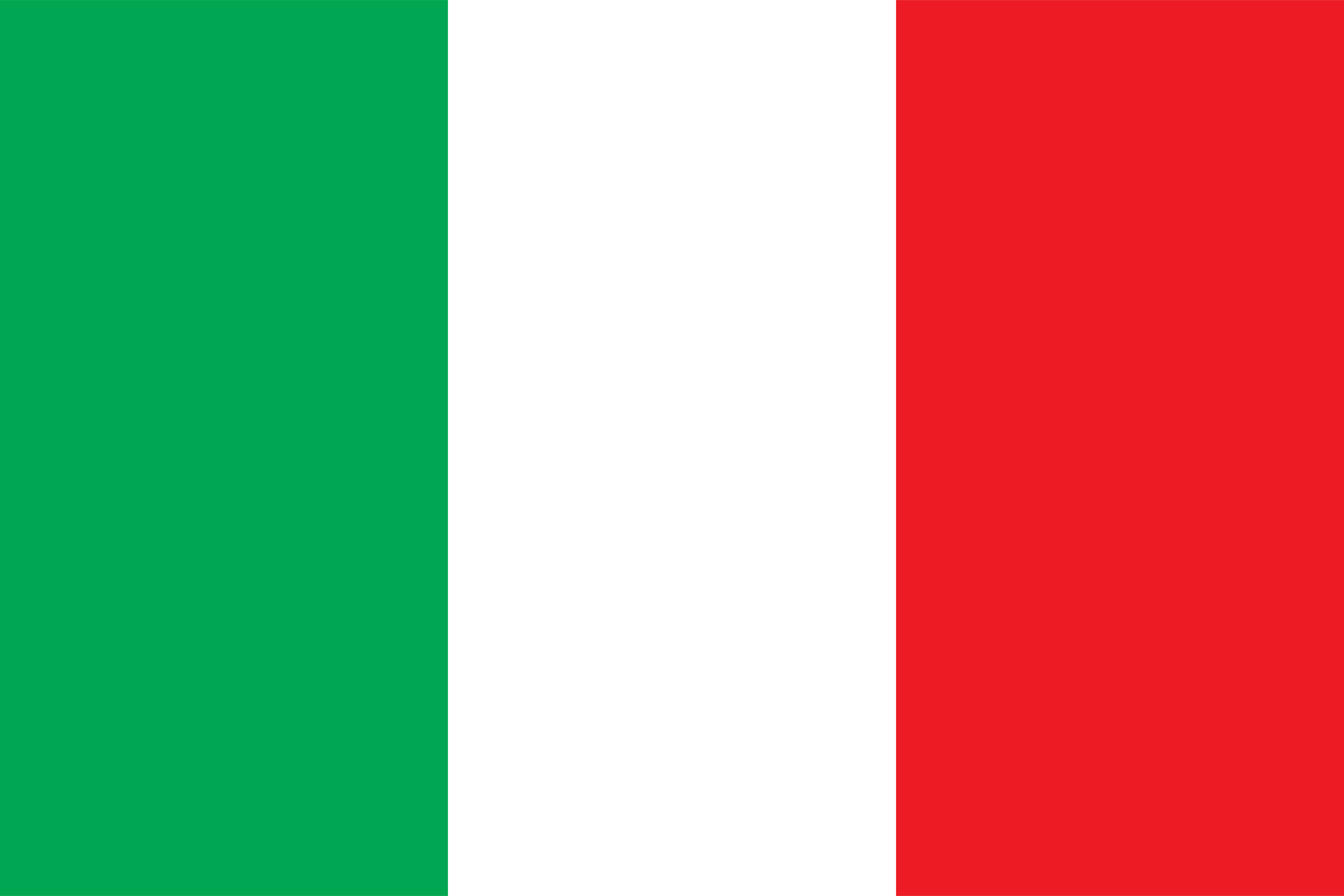
italy Flag
- Adopted
- 1 January 1948
- Proportions
- 2:3
- FIAV usage
- Used as civil, state and military flag, on land and at sea.
- Official status
- ⊕Officially adopted by national law
- Colors
- Designer
- —
- Predecessor
- Cispadane Republic flag (1797)
- Regulatory document
- DPR 121/2000
- Design family
- Horizontal tricolour
Four eras of the tricolore
The two-century arc of the green-white-red can be cleanly divided into four phases. Each is defined less by design — the bands have shifted only marginally — than by the political object the flag was attached to.
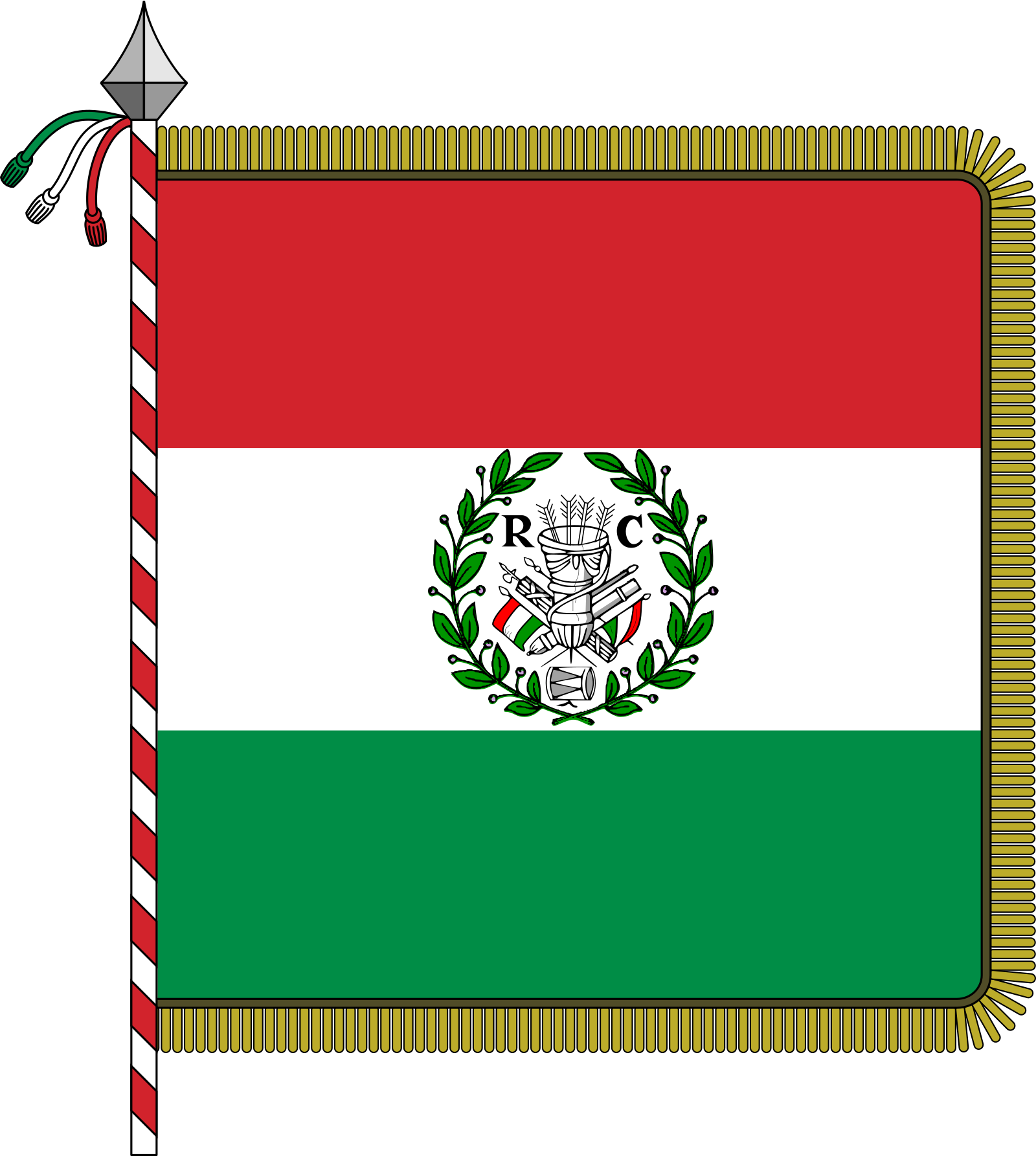
1797-1861: republican origins. The first official adoption is documented in the records of the Cispadane Congress — a short-lived Napoleon-allied assembly of cities south of the Po river. On 7 January 1797 it met in Reggio Emilia and resolved that the new republic would fly a horizontal tricolour: red at top, white in the middle, green at the bottom, with a central emblem of a quiver and four arrows for the provinces of Bologna, Ferrara, Modena and Reggio. The Cispadane Republic lasted barely six months before merging into the larger Cisalpine Republic on 29 June 1797, but the colour scheme persisted. Across the next sixty years the tricolore became the universal banner of the Risorgimento — flown by Giuseppe Mazzini’s Young Italy movement from 1831, the short-lived Roman Republic of 1849, and Garibaldi’s volunteer “Thousand” who sailed from Genoa to Sicily in 1860 to topple the Bourbons.
1861-1946: the monarchical century. When the Kingdom of Italy was proclaimed on 17 March 1861 — unifying most of the peninsula under the House of Savoy — the tricolore was rotated to vertical bands and charged in the centre with the Savoy coat of arms. The flag was never legally defined by the Albertine Statute itself, but custom and royal decree fixed the pattern. In 1925, Mussolini’s regime added the so-called Bandiera-Stato heraldic complement (royal coat of arms with lictor’s fasces) to the state ensign — surviving until 1944, when the Allied-backed government in the south restored a plain Savoy version. From 1943 to 1945, two flags flew simultaneously across the peninsula: the Savoy-armed tricolore in the Kingdom of the South, and the lictor-bearing tricolore of the Italian Social Republic — Mussolini’s German-protected rump regime in the north.
1946-2000: republican modern. The institutional referendum of 2 June 1946 returned 12.7 million votes for the Republic against 10.7 million for the monarchy. King Umberto II left for Portuguese exile on 13 June; on 19 June the Council of Ministers, by Legislative Decree no. 1, removed the Savoy arms from the centre of the flag. The Constituent Assembly then enshrined the result in Article 12 of the Constitution of the Italian Republic, in force from 1 January 1948: “La bandiera della Repubblica è il tricolore italiano: verde, bianco e rosso, a tre bande verticali di eguali dimensioni.” That single sentence replaced three quarters of a century of customary law.
2000-present: codified protocol. The constitutional minimum was just that — a minimum. For more than fifty years the operational rules (when to fly, at what height, alongside which other flags) were a patchwork of ministerial circulars. DPR 121 of 7 April 2000, issued under President Carlo Azeglio Ciampi, consolidated the protocol into a single regulatory document. It specifies the Pantone shades (Fern Green 17-6153, Bright White 11-0601, Flame Scarlet 18-1662 in the 2004 update), the order of precedence with the European Union flag, the buildings on which display is mandatory, and dimensions for indoor versus outdoor use. Ciampi’s broader institutional project of the early 2000s — restoring 2 June as a fixed date, reinstating the military parade after the 1977 austerity cut, sending the Frecce Tricolori over the Roman Forum — fits inside the same logic.
Spotlights
Reggio Emilia, 7 January 1797: the first vote
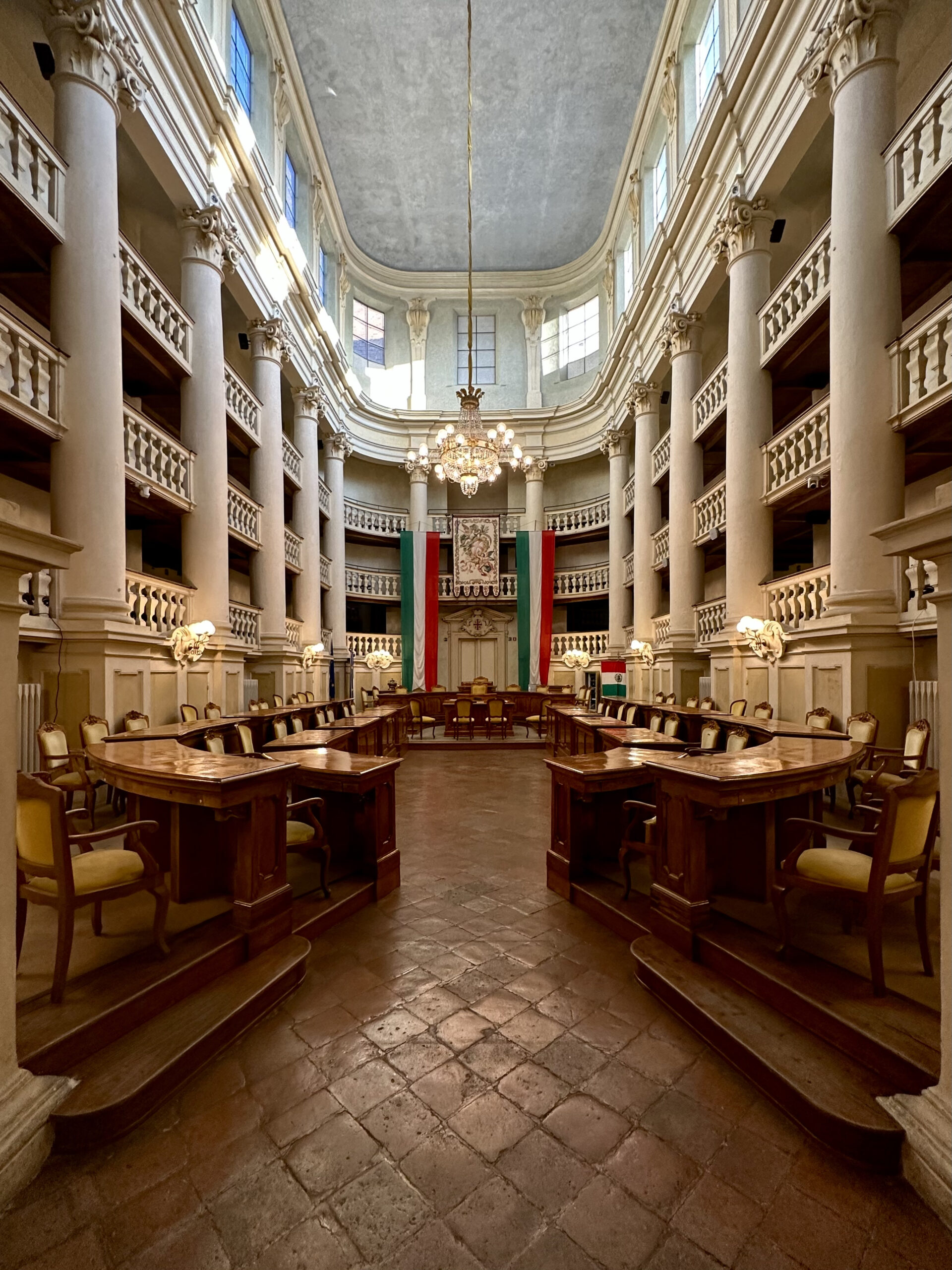
The Sala del Tricolore in Reggio Emilia — today the city’s municipal council chamber — preserves the room where the Cispadane Congress voted, on the motion of deputy Giuseppe Compagnoni, that “si renda Universale lo Stendardo o Bandiera Cispadana di Tre Colori Verde, Bianco, e Rosso.” The Italian Republic now observes 7 January each year as Festa del Tricolore, a quieter civic anniversary parallel to 2 June. The 1797 design was horizontal, not vertical, and the colour order was reversed from the modern flag (red at top), but the chromatic identity is unambiguous. Whether Compagnoni borrowed the palette from the Lombard Legion’s cockades, the Bologna Civic Guard banners of 1796, or earlier Milanese militia uniforms is the subject of decades of vexillological dispute; the Quirinale’s official history settles on the Civic Guard pennants as the most plausible direct ancestor.
1848 and the Carta of Carlo Alberto
The Albertine Statute — the constitutional charter promulgated by King Charles Albert of Sardinia on 4 March 1848, which would remain Italy’s de facto constitution for the next century — did not, contrary to widespread belief, contain a flag clause. The decision to adopt the tricolore as the banner of the Kingdom of Sardinia was a separate royal proclamation of 23 March 1848, issued the same day as the declaration of war on Austria that opened the First Italian War of Independence. The Savoy shield was to be superimposed on the central white band. That hybrid would be inherited unchanged by united Italy thirteen years later.
1925: the Bandiera-Stato
Royal Decree 2072 of 24 September 1923 had already standardised the Kingdom’s flag proportions at 2:3 and confirmed the Savoy charge. The 1925 amendments introduced the Bandiera-Stato — a distinct version reserved for state buildings, decorated on the central band with the full royal coat of arms: Savoy cross, crown, mantle, and the lictor’s fasces (the bundle of rods that gave Fascism its name and visual signature). After 25 July 1943, with Mussolini’s fall from power, the fasces were ordered removed; the Allied-backed Brindisi government restored the pre-1925 Savoy version. The Italian Social Republic at Salò continued to fly a tricolore with the fasces, and additionally a war ensign with a black eagle clutching them.
2 June 1946: the referendum that fixed the colour question
The ballot offered Italians two choices — Repubblica or Monarchia — with the republican option illustrated by the allegorical figure of Italia turrita (Italy crowned with a mural tower) and the monarchical option by the Savoy arms. The Republic won with 54.3% of valid votes (12,718,641 against 10,718,502 for the monarchy), with marked regional divergence: the North voted Republic by clear majority, the South kept the monarchy. The flag question was settled simultaneously and almost as an afterthought: with no king, no Savoy arms; with no arms, the bare tricolore. Legislative Decree no. 1 of 19 June 1946, signed by acting head of state Enrico De Nicola, removed the charge.
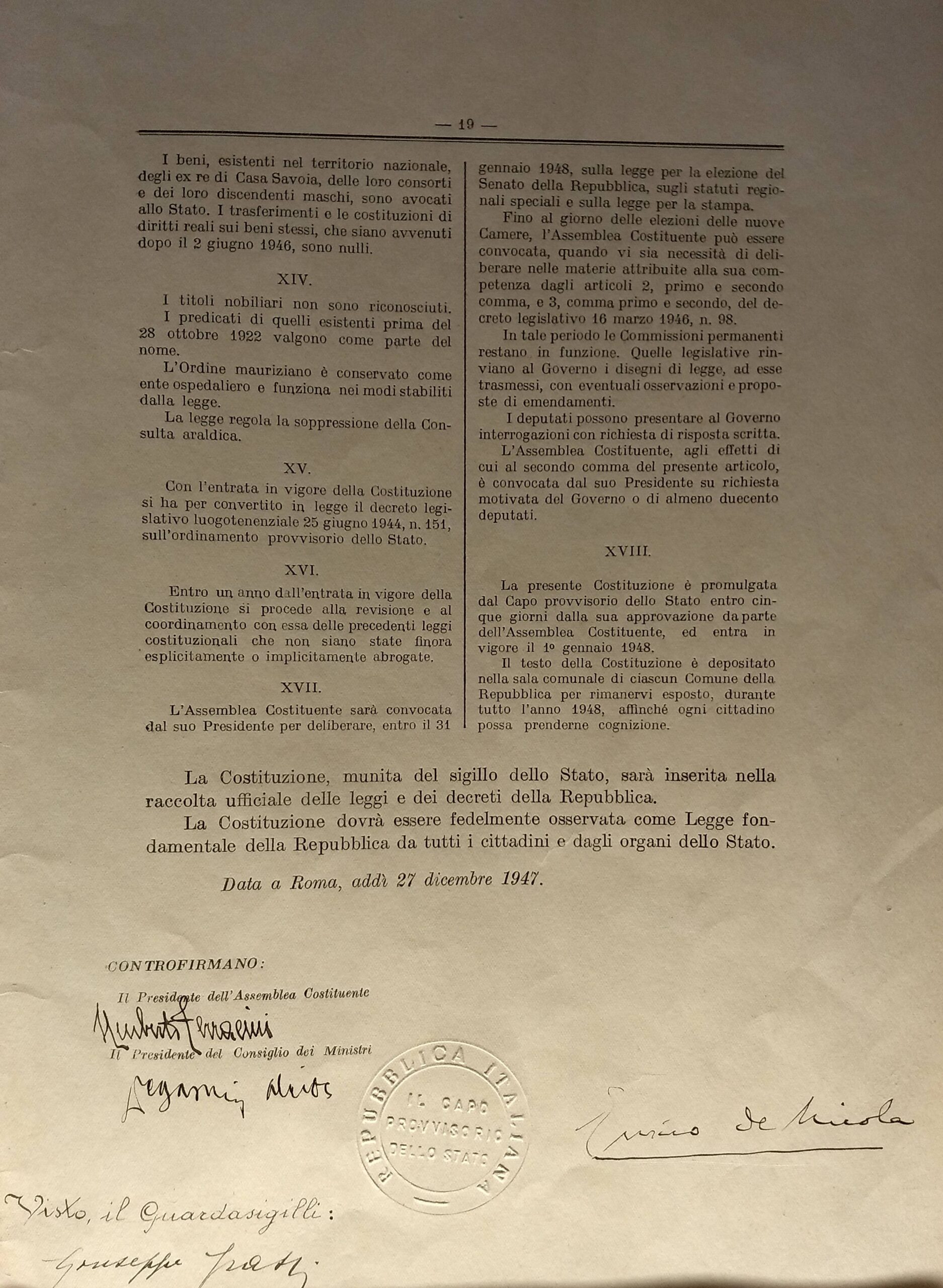
1947: Article 12 of the Constitution
The Constituent Assembly debated the flag clause on 24 March 1947 with notable brevity — there was no serious alternative on the table. The adopted text is one of the shortest articles in the entire Constitution: twenty-two words in Italian. Its placement in the “Fundamental Principles” section, alongside Article 1 (“Italy is a democratic Republic, founded on labour”) and Article 11 (repudiation of war), gives the flag the same constitutional weight as the form of government, the national language, and the relationship with the Church. The Italian Constitution thus enshrines a national flag at a structurally higher level than the French Constitution of 1958, where the tricolore appears in Article 2 alongside the language and the anthem, or the German Grundgesetz (Federal Republic of Germany’s 1949 constitution), where the federal colours are set in Article 22.
DPR 121 of 7 April 2000
DPR 121 — short for Decreto del Presidente della Repubblica, a presidential implementing regulation — runs to nine articles and an annex. It establishes that the flag must be displayed continuously on the buildings hosting the Presidency, the chambers of Parliament, the Constitutional Court, the Council of Ministers, and the highest organs of the magistracy. On other public buildings, display is mandatory on a closed list of civic days: 7 January (Tricolour Day), 11 February (Lateran Pacts), 25 April (Liberation), 1 May (Workers), 2 June (Republic), 4 November (Armed Forces), and during elections. The flag of the European Union must fly to the left of the Italian flag from the observer’s viewpoint, at equal height, with the tricolore in the position of honour. The construction sheet annexed specifies the 2:3 ratio for outdoor flags, 1:1 for table flags, and the Pantone references.
Frecce Tricolori: the flag in flight
The Pattuglia Acrobatica Nazionale — the Italian Air Force’s national aerobatic squadron, based at Rivolto in Friuli — has since 1961 trailed green, white and red smoke over Italian civic ceremonies. Ten Aermacchi MB-339 jets (in service since 1982; the team itself dates to 1961 and previously flew the F-86 Sabre and G.91) produce a horizontal tricolour in formation visible from the ground. The 2 June flyover of the Roman Forum is the team’s highest-profile annual appearance, but the same formation regularly travels to international air shows, where it functions as a flying ambassador of the flag itself. Few national flags have an associated aerobatic team of comparable visibility; the closest analogues — Spain’s Patrulla Águila, the French Patrouille de France, the British Red Arrows — all post-date or were modelled on the Frecce.
Balcony display: the unwritten tradition
The civic ritual most familiar to ordinary Italians is the hanging of the tricolore from balconies on 2 June and 25 April — a practice not codified by DPR 121 but encouraged by successive presidential addresses, particularly during the pandemic of 2020-21 when the gesture took on additional weight. Households are expected to attach the flag with the green band closest to the wall (so green appears on the left when viewed from outside), to use a flag in good condition, and to remove it at sunset unless illuminated. None of these conventions has the force of law for private displays; they survive as oral tradition reinforced by school civics curricula and ministerial guidance. For households shopping the official institutional cloth — woven to the DPR 121 ratio and Pantone references — Italian manufacturers continue to supply the domestic market with flags made to the standard size and proportions, distinct from souvenir or sporting versions.
Common ground and divergences with other republican tricolores
The Italian flag belongs to a recognisable European family: the vertical tricolour with one cool colour, white in the middle, and one warm colour, born of the French Revolutionary precedent. France formalised the vertical bleu-blanc-rouge on 15 February 1794 by decree of the National Convention. Italy’s 1797 adoption is older than France’s law but the chromatic concept is unmistakably French in inspiration. The same template recurs in Romania (1834, finalised vertical in 1848), Hungary (horizontal, 1848), Belgium (vertical, 1831), Ireland (1848, constitutionally enshrined 1937), and Mexico (1821).
The divergences are instructive. Italy’s green is the family’s distinguishing element, often attributed to Lombard Civic Guard uniforms. Ireland’s orange-white-green inverts the warm-cool placement to encode the Catholic-Protestant settlement. Hungary’s horizontal red-white-green is graphically the closest to the Italian flag with the bands rotated — a continual source of misidentification at international sporting events. The Italian variant is therefore both a member of the family and a member with a precise, immediately recognisable accent.
Practical takeaways
For European readers attending or organising a 2 June event, the DPR 121 protocol is straightforward in the essentials:
- Order with the EU flag: Italian tricolore on the right from the observer’s viewpoint (position of honour), EU flag on the left, both at equal height. A third regional or municipal flag goes to the left of the EU flag, never between the two.
- Orientation: green band closest to the flagpole or wall; red band furthest out. For horizontal display from a balcony, green to the left when viewed from outside.
- Indoor: 1:1 table flags, mounted to the right of the speaker from the audience’s perspective.
- Mourning: half-staff display is authorised only by presidential or prime ministerial decree.
- Sunset rule: outdoor flags must be lowered at sunset unless illuminated; standard for government buildings and the conventional standard for private balconies.
- Condition: a torn, faded or visibly degraded flag should be replaced; customary disposal practice is respectful burning, mirroring conventions adopted in Italian Boy Scout and military manuals.
Reference table
| Year | Event | Flag change | Source |
|---|---|---|---|
| 1796 | Bologna Civic Guard pennants | Green-white-red cockades and unit colours, claimed precursors of the tricolore | Quirinale, official tricolore history |
| 1797 | Cispadane Congress, Reggio Emilia (7 January) | First official adoption — horizontal red-white-green with central emblem (4 arrows in laurel) | Cispadane Republic records; Busico 2005 |
| 1848 | Royal proclamation of Charles Albert (23 March) | Tricolore adopted by Kingdom of Sardinia, vertical bands, Savoy shield added | Carta Albertina supplementary decrees |
| 1861 | Proclamation of the Kingdom of Italy (17 March) | Sardinian tricolore extended to unified Kingdom; Savoy shield retained | Royal Decree of unification |
| 1925 | Fascist state heraldic regulations | Bandiera-Stato with Savoy arms, crown, mantle and lictor’s fasces | Royal Decree 2072/1923 + 1925 amendments |
| 1943 | Fall of Mussolini, dual flags (25 July) | Pre-fascist Savoy tricolore restored in Kingdom of the South; lictor variant retained by Salò | Allied Control Commission records |
| 1946 | Institutional referendum (2 June) | Savoy arms removed by Legislative Decree 1/1946 (19 June); plain tricolore restored | DLLT 1/1946; Gazzetta Ufficiale |
| 1947 | Constitution of the Italian Republic (Article 12) | Constitutional codification: green, white, red, vertical, equal bands | Costituzione della Repubblica Italiana |
| 2000 | DPR 121 of 7 April | Comprehensive display regulation; Pantone shades; EU precedence rules | DPR 121/2000; Gazzetta Ufficiale n. 112 of 16 May 2000 |
| 2001 | Restoration of 2 June as fixed holiday | No flag change; civic ritual reinstated under President Ciampi | Law 336/2000; Presidential addresses |
Sources and further reading
- Festa della Repubblica — overview and parade history (2026) — en.wikipedia.org
- Flag of Italy — comprehensive history, design specifications, Pantone references (2026) — en.wikipedia.org
- Constitution of Italy, Article 12 — text of the constitutional flag clause (1947) — en.wikipedia.org
- DPR 121 of 7 April 2000 — Regolamento sull’uso della bandiera della Repubblica italiana e di quella dell’Unione europea (2000) — gazzettaufficiale.it
- Cispadane Republic — first official adoption, 7 January 1797 (1797) — en.wikipedia.org
- Wanted in Rome — Festa della Repubblica context for the 2 June public holiday (2026) — wantedinrome.com
- Idealista Italy — Republic Day 2026 explained (2026) — idealista.it
- Quirinale — I simboli della Repubblica: il tricolore (ongoing) — quirinale.it
- Busico, Augusta — Il tricolore: il simbolo, la storia, Presidenza del Consiglio dei Ministri (2005)
- Maiorino, Tarquinio; Marchetti Tricamo, Giuseppe; Zagami, Andrea — Il tricolore degli italiani, Mondadori (2002)
Note on sources: this article draws on primary legal texts (Article 12 of the Italian Constitution, DPR 121/2000, the Albertine and republican legislative decrees) and on the official tricolore history maintained by the Quirinale. Some elements of contemporary balcony-display practice — the sunset rule, the orientation conventions, the disposal procedure — are not codified in DPR 121 and survive as customary practice reinforced by school civics curricula and ministerial guidance rather than as black-letter law. Readers with primary documentation on these informal conventions, particularly from regional or municipal protocols, are warmly invited to write in with corrections.
🔍 Sources & verification
Key factual claims in this article are tracked in our claim ledger and checked against their sources. Read how this works in our methodology.
✅ 5 verified claims
- Gazzetta Ufficiale n. 131 for DPR 121/2000 (www.gazzettaufficiale.it, verified Jun 1, 2026)
- ELI link eli/id/2000/05/22/000G0166/sg for DPR 121 (www.gazzettaufficiale.it, verified Jun 1, 2026)
- Pantone 2004 update for tricolore standardisation
- Frecce Tricolori since 1961 trailed green-white-red smoke
- Carlo Alberto separate proclamation 23 March 1848 for flag